Log Cabin Construction
Where to Get Logs and How to Move Them
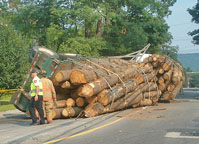 How NOT to Move Logs
In log cabin construction your most important component is the trees. Good trees are not hard to find. Many trees that would be perfect for a log cabin are cut up for firewood every year.
The easiest (but most expensive) option in log cabin construction is to buy your logs from a saw mill. They can be cut to length and even sawn on both sides. You pay a premium for this but avoid a lot of work.
If you call tree trimmers around your area, you may be able to find a source for cheaper logs. Most tree trimmers sell the trees they take down as firewood. Making money on a tree without that extra labor is good business for them. Try to make friends with some tree trimmers and get them interested in your log cabin construction project!
Cutting Your Own Logs
If you have access to land with good straight trees 18-24”+ in diameter that is a start. If a neighbor has some woods and will let you cut, this will work also. You will need a tractor at least 40 hp to move any logs this size but be ready to break something. A bigger tractor around 70+ hp would be better. I use a 3 pointt hitch with a heavy bar attached.When checking out a potential tree, walk up to it and look straight up from all sides. Does it curve? If not then mark it as a usable tree. You can carry a notepad around in the woods, making notes as you go. I number my trees, marking enough to fill the number I needed. After all trees are marked, I wait for a nice calm day and began cutting.
For my cabin in Michigan, it took my dad
and me several hours to cut down all the trees. Out of thirty trees we
had four hang up in other trees and two or three split. The hang ups
were in an area where the trees are very dense.
After a week and a storm, they fell. The other splits were my fault. My saw was not big or fast enough. I lost some nice straight logs that day. I had some trees that were infested with carpenter ants. Needless to say I was not a happy camper. You may want to pick three or four extra trees for these type situations.
Once you have
all your trees on the ground you have to take inventory of your log
cabin construction project. Now is the time of truth where you see how
straight and long these logs really are. You have to
carefully plan out where each log will be used in the log cabin
contruction.
Keep your four biggest diameter and length logs for sills
and top plates. These four logs should be straight and solid. Remember
to cut the top plate logs at least two feet longer than the other logs
for the front and back. These are longer to support your gable end
support logs. The number of doors
and windows will also determine how many full length logs are needed.
Often you may be able to get two logs from one tree. If you need a 20’ log and the straight area of the tree is 30’, you now have one of your long logs and a smaller log for near a window. Just as the rest of log cabin construction, log choice is common sense.
Moving the logs is a
fun experience. Sometimes it is hard to get to the
log if the woods are thick. Also you may have to dig under the log end
to get a chain around it.
You want to keep the log off the
ground as much as possible as you pull it through the woods. It cuts
back on resistance from the
dragging and doesn’t tear up the ground as much. The less dirt that
gets in the bark, the better off your saw teeth will be.